



 7 / 84

5
For further information, please contact your local dealer or visit our web site:
www.jcunitec.com包丁の分類【和包丁】
Traditional Japanese Knife Classifications
和包丁の製法は大きく分けて本焼と霞(付け鋼)とに分けられます。
本焼とは鋼の無垢が材料で霞とは鋼と鉄を鍛接した物が材料です。本焼の和包丁
の利点は切れ味が長持ちし刃研ぎによる型くずれしにくいという点です。欠点として
は製法が難しいため商品にバラツキが出る事や硬い為に小刃欠け(刃先が小さく欠
けること)したり研ぐのに時間がかかる事、価格が高い事などです。前記のような理
由の為、本焼の和包丁はかなり刃研ぎの経験を積んだ人でなければ本来の利点を
生かすことができず、欠点だらけのものになってしまいます。
霞(付け鋼)の包丁は本焼に比べ比較的価格も安く裏に鋼、表には軟鉄を鍛接して
いる為研ぎやすく大きく欠けにくいという利点があります。しかし切れ味が落ちるの
が早かったり、表と裏で違う材質を鍛接している為に包丁が裏に向かって(軟鉄の膨
張により鋼が押されるため)反ってくることがあるという欠点があります。どちらの製
法で作った包丁も一長一短がある為使う人も使用法や力量に合った包丁を選ぶこと
が大切です。
また最近はステンレス系の材料を使った和包丁も、各メーカーが製造・販売を始め
従来の鋼に比べより硬くサビに強いといったステンレス鋼の利点を生かした和包丁も
多く見られます。
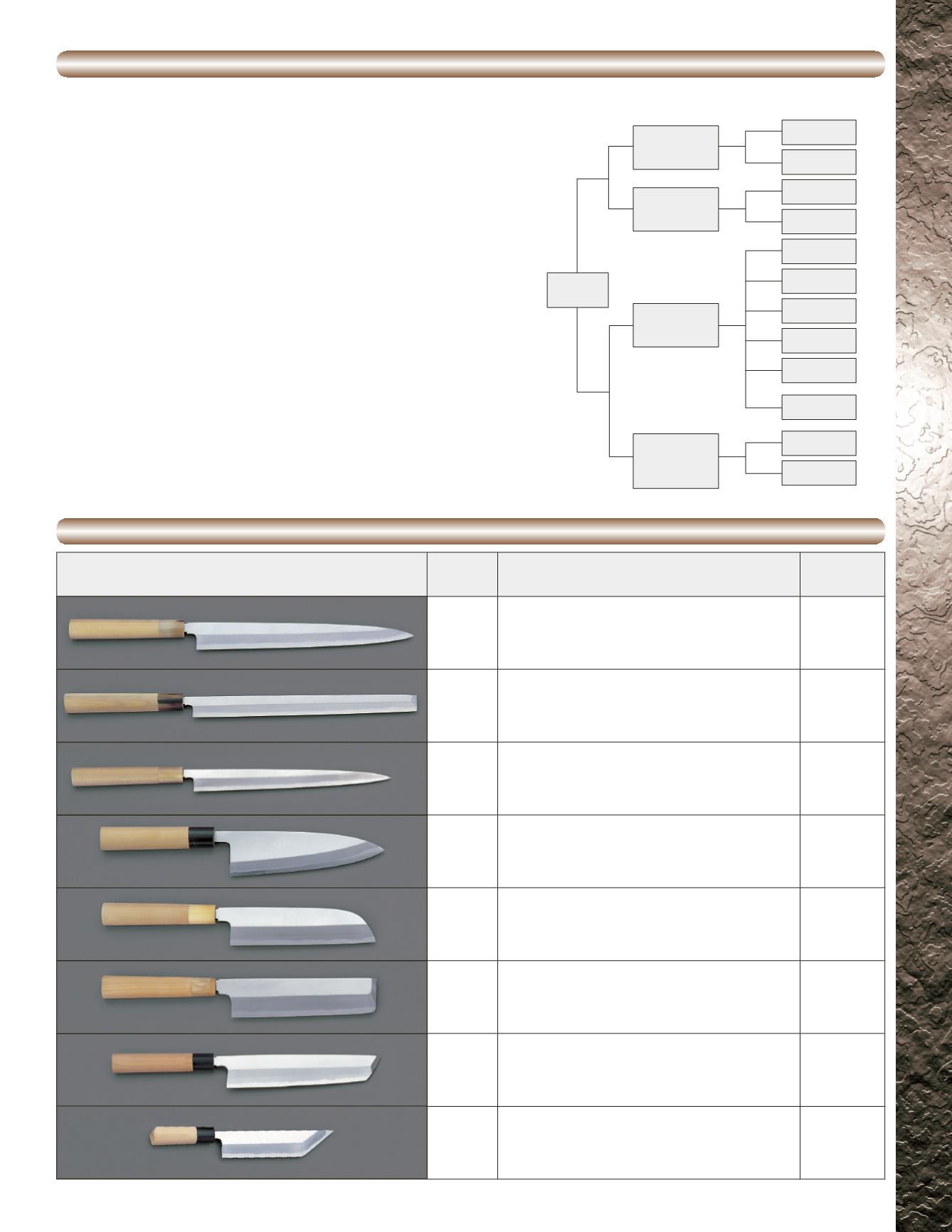
Japanese knives are categorized based upon the materials used and the forging technique.
(See chart on right.)
There are two classifications of materials for traditional Japanese knives - knives made
from one material (honyaki) and knives made from two materials (kasumi).
Honyaki knives are extremely difficult to make. Forging techniques of honyaki knives
have developed over a long history and only highly skilled Meisters are able to use such
techniques. The resulting knives are superior in strength, sharpness, and durability.
Maintaining a honyaki knive is also difficult as improper sharpening and cleaning can
easily damage it.
Kasumi knives are easier to make and maintain compared to the honyaki knives. They are
made of two materials and are thus softer. Kasumi knives are also relatively inexpensive.
形 状
Blade Shape
名 称
Name
用 途
Applications
使用し易い
サイズ(mm)
Popular sizes (mm)
柳 刃
Yanagi-ba
元々は関西型の刺身包丁だが現在は全国的、関
西では正夫「しょうぶ」とも呼ぶ。
The most commonly used knife for preparing sashimi. Other soft
to firm foods can also be prepared using the yanagi-ba.
240〜300
蛸 引
Tako-biki
元々は関東型の刺身包丁だが最近は柳刃に押さ
れ使う人が減っている。
The Tako-biki is more commonly used among the eastern regions
of Japan and has the same applications as the Yanagi-eastern.
240〜300
ふぐ引
Fugu-biki
ふぐ等の薄造り用で柳刃より幅も厚みも薄い。てっ
さ包丁とも呼ぶ。
Having a thinner blade than the yanagi-ba, the Fugu-biki is a specialty
knife designed for cutting paper-thin slices of the blowfish. Can be
used for other applications requiring precise and accurate cutting.
240〜300
相出刃
Deba
魚や鳥をさばく物だが厚みや長さによってかなり
の種類に分かれ用途は広い。
The Deba is an all purpose knife. It can be used to prepare poultry,
fish, meat, vegetables and other types of food.
150〜240
鎌形薄刃
Kamagata-Usuba
(Thin-Bladed)
関西型の野菜切で小さい物は面取りなどの細工包
丁として使用する。
The Kansai version of the Usuba, this knife is more versatile with
its pointed tip. It can be used for regular cutting as well as for
creative cutting of vegetables.
165〜240
薄 刃
Usuba
(Thin-Bladed)
関東型の野菜切で一般的には片刃だが両刃の物
もある。
The most versatile vegetable knife, the Kanto style Usuba is the
most popular multipurpose vegetable knife.
165〜240
鱧 切
Hamo Kiri
鱧等の小骨の多い魚を細かく切る為の包丁。
Knives of this type are used for cutting bony fish, such as sharp-
toothed eel.
240〜300
鰻 裂
Unagi-Saki
(Eel Knife)
関東型のうなぎ裂、他に大阪型や京都型、名古
屋型などがある。
Knives of this type are used for cutting eel. Different styles are also
available depending on the region of Japan (i.e. Osaka, Kyoto, and
Nagoya)
150〜240
8A鋼
8A ko
銀三鋼
Ginsanko
黄 鋼
Kiiko
白 鋼
Shiroko
白三鋼
Shirosanko
白二鋼
Shironiko
白二鋼
Shironiko
青二鋼
Aoniko
銀三鋼
Ginsanko
銀三鋼
Ginsanko
白 鋼
Shiroko
青 鋼
Aoko
鍛 造
Tanzou
(ステンレスと
ステンレス鋼)
SUS & SUS ko
鍛 造
Tanzo
(鉄とハガネ)
Tetu & hagane
本 焼
Honyaki
ステンレス
SUS
本 焼
Honyaki
鋼
Hagane
和包丁
Waboucho
材 質
Materials
製 法
Forging Method
和包丁の種類と用途
Types and Applications of Japanese Knives